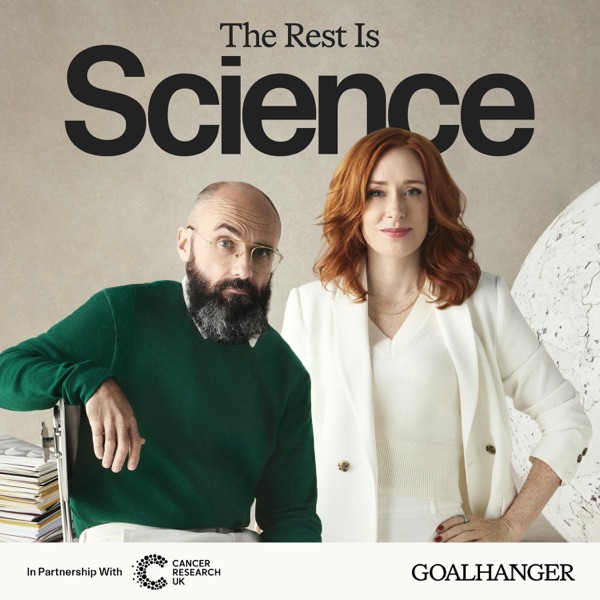
Join mathematician Professor Hannah Fry and science creator Michael Stevens (Vsauce) as they dig into the weird scientific questions that often go unexplored.
Welcome to The Rest Is Science, a show that sits in the fascinating space between what we think we know, and what we actually know. Why do we assume we understand things like time, randomness, or even gravity? Once you start questioning these familiar ideas, reality becomes astonishingly strange and completely fragile.
Whether you're a lifelong science fan or just naturally curious, The Rest Is Science will change your perception of reality, and prove that the biggest questions are always the most fun.
00:00
00:00
Episode's summary
In this 100th episode of The Rest is Science, Michael and Hannah debate whether the number 100 or 101 is superior. They explore various mathematical and historical perspectives, including the etymology of 'hundred', the benefits of base 12, the primality of 101, and the psychological impact of numerical thresholds in human behavior.
The conversation further explores the arbitrary nature of the Kármán line at 100 kilometers and the origin of '101' as an introductory course designation. The hosts also discuss scientific phenomena involving element 100 (Fermium) and conclude with a mathematical exploration of Roman numerals being alphabetized.
Chapters
Click on a chapter to go directly to that moment
Highlights
But the point is that 100 meant six score. And a score is 20. So 100 meant 120, what we call 120 today.
00:01:25 · Hannah explains the historical linguistic roots of the 'long hundred' in Northern Europe.
And I think there's a strong argument that base 12 is vastly superior in all kinds of ways.
00:05:54 · Michael argues for the mathematical efficiency of a duodecimal system over the decimal system.
a car with 79,900 miles will sell on average for $210 more than than one with 80,100 miles.
00:09:49 · Michael provides an economic example of how humans are psychologically influenced by round number thresholds.
It's prime. Yeah, it's named after a demon. It is one of the seven princes of hell.
00:14:36 · Hannah discusses a massive palindromic prime number that carries an interesting mythological association.
So 100 protons in the nucleus is like this kind of magical cliff.
00:38:56 · The speaker describes how element 100 represents a limit to building heavier elements via neutron addition.
In this 100th episode of The Rest is Science, Michael and Hannah debate whether the number 100 or 101 is superior. They explore various mathematical and historical perspectives, including the etymology of 'hundred', the benefits of base 12, the primality of 101, and the psychological impact of numerical thresholds in human behavior.
The conversation further explores the arbitrary nature of the Kármán line at 100 kilometers and the origin of '101' as an introductory course designation. The hosts also discuss scientific phenomena involving element 100 (Fermium) and conclude with a mathematical exploration of Roman numerals being alphabetized.
Published01 Nov 2026
Duration44:50
Episodes
102-
Is 100 Better Than 101?
Listened
In this 100th episode of The Rest is Science, Michael and Hannah debate whether the number 100 or 101 is superior. They explore various mathematical and historical perspectives, including the etymology of 'hundred', the benefits of base 12, the primality of 101, and the psychological impact of numerical thresholds in human behavior.
The conversation further explores the arbitrary nature of the Kármán line at 100 kilometers and the origin of '101' as an introductory course designation. The hosts also discuss scientific phenomena involving element 100 (Fermium) and conclude with a mathematical exploration of Roman numerals being alphabetized.
01 Nov 2026
101-
What Are These Unsettling Sounds?
Listened
The hosts explore historical audio recordings, ranging from the earliest known recording of a human voice in 1860 to large-scale crowd recordings from 1888. They discuss the technology behind phonautographs and wax cylinders, as well as the scientific possibility of capturing sound in physical objects like clay pots.
The episode also covers the scientific discovery of the BRCA2 gene and investigates mysterious underwater sounds recorded by hydrophones. The discussion details how researchers used modern technology to identify the origins of sounds like the 'Biotwang' and the 'Bloop'.
29 Oct 2026
100-
Earth’s Tilt Makes Time Slippery
Listened
The hosts explore the complexities of solar time, discussing how Earth's axial tilt and irregular orbit create discrepancies between sundials and standardized civil time. They delve into the mechanics of the equation of time, the concept of sidereal days, and the use of specialized tools like the SunQuest sundial to correct for these astronomical variations.
The episode also covers the history of mass-produced sundials and the phenomenon of the subsolar point, specifically 'Lahaina Noon' in Hawaii. The conversation concludes with explorations of planetary proximity calculators, the vastness of the Pacific Ocean, and a philosophical reflection on following one's own rhythm versus societal time.
25 Oct 2026
99-
What Happened When We Stopped Squatting?
Listened
In this episode of Field Notes, Michael and Hannah explore the intersection of human history, biology, and physics. The discussion begins with the mechanics of squatting, examining how traditional tools like the Kenyan 'ekiholon' and habitual squatting leave physical marks on the human skeleton, as seen in both modern humans and Neanderthals.
The episode then transitions into the evolution of chairs and their impact on posture, before diving into the physics of air pressure and motion. The hosts examine the counterintuitive behavior of helium balloons in moving cars and conclude with a look at how gas density affects sound resonance and the rhetorical function of tautologies in language.
21 Oct 2026
98-
Mathematicians Are The Canary Down The AI Coal Mine
Listened
The hosts explore the intersection of artificial intelligence and fluid dynamics, beginning with OpenAI's use of AI agent swarms to approach the Navier-Stokes problem. The episode provides an educational deep dive into the mathematics of fluids, covering the continuum approximation, Newtonian viscosity, and the complexities of solving these fundamental equations.
The discussion further examines the implications of AI-generated mathematical proofs, specifically addressing the tension between achieving correct results and maintaining human-readable scientific insight. The speakers conclude by analyzing the stages of AI development—interpolation, extrapolation, and abstraction—and what the automation of mathematics means for the future of human discovery.
18 Oct 2026
97-
The Right Way To Open A Shaken Soda Can
Listened
The hosts demonstrate a life hack for preventing carbonated beverages from exploding by tapping the sides of the can, while exploring the physics of pressure in cans and aircraft. The discussion transitions into the scientific replication crisis, examining how human bias and the pressure to publish can lead to false results.
The episode further explores the relationship between scientific doubt and curiosity, arguing that certainty often leads to thoughtlessness and danger. Drawing parallels between historical atrocities and modern trends toward automation, the speakers conclude that fostering diverse perspectives and questioning is essential for maintaining a healthy society.
14 Oct 2026
96-
Something Weird Is Going On With Placebos
Listened
The hosts explore the increasing effectiveness of placebos, particularly in America, where the gap between real drugs and inert treatments is narrowing. They examine scientific theories behind this phenomenon, including the roles of pharmaceutical advertising, clinical trial length, and the psychological impact of medical rituals.
The discussion extends to how uncertainty and belief shape reality, from the 'Tinkerbell effect' in medicine to self-fulfilling prophecies in the stock market. The episode also touches on the risks of unnecessary medical interventions and the use of 'placebo buttons' and industry codes in everyday life.
11 Oct 2026
95-
What Was A Mammoth Doing At The Bottom Of The Sea?
Listened
The hosts explore the prehistoric landscape of Doggerland, a lost landmass once connecting the UK to mainland Europe, using evidence from a fossilized mammoth vertebra and 3D seismic surveys. The discussion covers the geological destruction of this landscape by a massive tsunami approximately 8,000 years ago and examines ancient hominid footprints discovered in Norfolk.
The episode also shifts to sociological and psychological themes, tracing the historical emergence of 'coolness' in the 1930s and the biological drivers behind the 'stank face' reaction to music. Finally, the hosts discuss recent reading material, including works by Andy Weir and Terry Pratchett, reflecting on how communication shapes the human sense of self.
07 Oct 2026
94-
Why Do We Turn on Innocent People?
Listened
The hosts explore the psychology and history of false accusations, examining how personal motives, confirmation bias, and belief perseverance transform unfounded suspicions into perceived certainties. Using cases like Richard Jewell and the McMartin Preschool satanic panic, they illustrate how individuals use the power of authorities to settle grievances and how people retroactively interpret evidence to fit preconceived narratives.
The discussion further delves into the mechanics of social conformity and digital outrage, highlighting how social media amplifies misinformation and makes it difficult to express disagreement. The episode also examines the dangers of media leaks in criminal investigations and uses the game Mafia as an analogy for how accusations are often used to assert identity and values rather than seek truth.
04 Oct 2026
93-
Hacking The Kendama With Physics
Listened
Michael Stevens introduces the physics of the kendama, comparing traditional versions to a specialized Delrin version built by Adam Savage. The discussion explores how robotics researchers use similar tasks to teach machines about environment and physics, alongside the human joy found in experimentation.
The episode also delves into the physics of spinning objects like gyroscopes, fluid dynamics in swimming, and the dense, 'fuzzy' core of Jupiter as studied by the Juno probe. The hosts conclude with recommendations for intuitive mathematics and statistics textbooks and a look at the book 'Hello World'.
30 Sep 2026
92-
Why Do We Like Staring Into Fire?
Listened
The hosts explore the chemical nature of fire, defining it as a process rather than a substance through the lens of the 'fire tetrahedron.' The discussion traces the evolutionary history of fire, from ancient wildfires to its intentional use by Neanderthals and Homo erectus, noting how Earth's oxygen levels were essential for its existence.
Beyond chemistry and history, the episode delves into the psychological impact of fire. By examining 'attention restoration theory,' the hosts contrast the restorative 'soft fascination' of watching a fire with the draining 'hard fascination' of modern digital consumption, suggesting that ancestral hearth-side activities fostered cognitive development and social connection.
27 Sep 2026
91-
The Fluid Dynamics of Fountain Pens
Listened
Hannah Fry and Michael Stevens explore the intricate physics and history of fountain pens, examining everything from capillary action and nib engineering to the evolution of luxury brands like Montblanc. The conversation transitions from the technical mechanics of writing instruments to a linguistic investigation into 'bad words'—terms that fail to communicate effectively due to structural or logical confusion.
The episode further delves into scientific and evolutionary mysteries, including the physics of aerodynamic lift through Bernoulli's principle and Newton's third law. The hosts conclude by reflecting on historical curiosities, such as the emergence of human language, animal communication in elephant seals, and the evolution of self-awareness.
23 Sep 2026
90-
Dying In Space, Trapped Water, and What's Hidden In Pi?
Listened
The hosts explore the history of space exploration, focusing on the Soyuz 11 mission and the three cosmonauts who became the first humans to die beyond Earth's atmosphere due to a technical failure. The episode contrasts this tragedy with other space disasters and reflects on the legacy of humanity's presence in outer space.
The conversation shifts from geography trivia regarding landlocked countries to environmental concerns about fresh water trapped in plastic landfills. The episode concludes with a mathematical exploration of the concept of being 'trapped,' examining animal behavior and the theoretical existence of all finite digit sequences within the infinite digits of Pi.
20 Sep 2026
89-
How Codes Were Used To Hack The Telegram Business
Listened
In this episode of Field Notes, Michael Stevens explores the history of communication, beginning with a 1900s telegraph codebook used to save costs through Latin phrases. The discussion traces how Samuel Morse's personal tragedy led to the invention of the telegraph, fundamentally shrinking the world and changing human connection.
The episode also delves into modern technology and physics, examining 'skeuomorphs,' why we rarely dream about smartphones, and the mechanics of angular momentum in drains. Finally, the conversation covers the physics of impact, deceleration, and how scale affects terminal velocity.
16 Sep 2026
88-
Why Your Body Needs Gravity
Listened
The hosts explore the real-world application of Einstein's twin paradox through the NASA experiment involving Scott and Mark Kelly, noting that while high-speed travel causes significant time dilation, the ISS experiment resulted in a difference of only milliseconds. The episode also examines the physiological and psychological effects of microgravity, including impacts on human vision, fluid distribution, and the distortion of circadian rhythms.
Furthermore, the discussion delves into the genetic and physical toll of spaceflight, detailing how extreme environments affect bone density, blood cell production, and gene expression. Specifically, the segment highlights unexpected changes in telomere length observed during Scott Kelly's time in orbit.
13 Sep 2026
87-
What Is Collagen All About?
Listened
The hosts explore the science and economics of collagen supplements, examining how proteins are extracted from animal waste products and discussing the need for skepticism regarding industry-funded research. The episode also delves into Ig Nobel Prize-winning studies, ranging from hand weight perception to the unique shape of wombat feces.
The conversation shifts toward mathematical philosophy, investigating whether the number two can exist without one through the lens of ancient Greek counting. Finally, the hosts discuss the interesting properties of periodic elements like indium and bismuth, concluding with a hypothetical scenario about the catastrophic chemical consequences of adding a single proton to every atom in the universe.
09 Sep 2026
86-
The Threshold of Human Sensation
Listened
This episode explores the scientific reality of human sensory thresholds, debunking common internet myths about absolute physical limits. The hosts examine how our perception varies by individual and investigate the incredible sensitivity of our senses, from the massive chemical scales required for emotion to the detection of single molecules through smell.
The discussion moves into the extremes of touch and light, investigating how humans can perceive minute structural differences in textures and even respond to single photons. The episode concludes by exploring the biological mechanics of vision, specifically how our photoreceptor cells function in darkness and the distinction between non-conscious physical detection and conscious visual experience.
06 Sep 2026
85-
The Scale of the Universe
Listened
The hosts explore the extreme scales of the universe, from the Planck length to the observable universe, debating whether the discrete nature of physics supports the simulation hypothesis. The conversation traverses mathematical constants like pi, Wikipedia rabbit holes, and the science behind 'shower thoughts' driven by the brain's default mode network.
The episode also covers scientific advancements in re-engineering antibodies for cancer treatment and the profound emptiness of space. Finally, the hosts address a correction regarding historical views on curiosity, emphasizing the importance of scientific humility and collective progress.
02 Sep 2026
84-
Why Loud Chewing Makes You Angry
Listened
The hosts explore the science and psychology of misophonia, investigating why specific frequencies—particularly between 2,000 and 4,000 hertz—trigger intense physical and emotional reactions. The discussion covers the mechanics of acoustic weapons like 'the Mosquito' and examines the neurological theory of 'hyper mirroring,' where the brain's involuntary response to oral sounds causes distress.
The episode further investigates how visual context can mitigate sound unpleasantness and why misophonia often manifests as anger rather than fear, viewing the sensation as a perceived boundary violation. Finally, the hosts compare the psychological overlap between misophonia and ASMR, while theorizing that the popularity of Mukbang may serve as a way to simulate communal eating in an era of increasing loneliness.
30 Aug 2026
83-
How Does Language Change What You Smell?
Listened
The hosts explore how language and vocabulary shape our perception of reality, debating the Sapir-Whorf hypothesis through examples ranging from sensory descriptions to grammatical structures. The discussion extends to how specific terminology provides clarity for neurodivergent identities and examines the relationship between language and time.
The episode also transitions into scientific territory, covering the physics of escape velocity, the mechanics of vacuum-based space delivery systems, and the chemistry of soap. Finally, the hosts reflect on historical scientific misconceptions like the 'rain follows the plow' theory and conclude with a discussion on the true nature of the scientific method as an exercise in falsification.
26 Aug 2026
82-
Space Elevators, Skyhooks, and Space Fountains
Listened
The episode explores the extremes of space travel, ranging from the violent physics of a 1957 nuclear test to the theoretical 'slowest' method: waiting for cosmic events like proton decay. The discussion covers the mechanics of orbital motion using Newton's Cannon and the Kármán line, alongside advanced infrastructure concepts like the space elevator, skyhook, and launch loop.
The conversation also addresses the cultural and social implications of space exploration. The hosts debate the shift from public-funded missions to private enterprise, comparing the privatization of space to the corporate nature of AI and reflecting on the tension between investing in terrestrial social needs versus grand scientific adventures.
23 Aug 2026
81-
Bizarre Watches and How They Work
Listened
Michael Stevens and Hannah Fry explore a collection of novelty timekeeping devices, ranging from a watch that only displays the word 'now' to a vintage 1995 Apple quartz watch. The episode also delves into the mechanics of Bayesian reasoning, using analogies like beanbags and targets to explain how the brain updates beliefs based on new evidence.
The discussion extends to the biological and psychological aspects of mathematics, examining whether mathematical ability is innate or influenced by factors like dyscalculia and working memory. The hosts highlight the importance of self-efficacy and how cultural attitudes toward failure and challenge shape mathematical persistence and understanding.
19 Aug 2026
80-
Why Your Brain Thinks You're Full (Even When You're Not)
Listened
This episode explores the biological mechanisms of blood sugar regulation and the scientific journey behind GLP-1 medications. The hosts trace the lineage of these drugs from the discovery of the glucagon gene in anglerfish to the study of Gila monster venom, explaining how scientists engineered stable synthetic versions like semaglutide.
The discussion further examines how GLP-1 affects hunger by acting on the brain and slowing digestion, contrasting this with the engineering of ultra-processed foods designed to bypass satiety. Finally, the episode looks toward the future, discussing how AI tools like AlphaFold are accelerating protein research and disease understanding, while acknowledging the potential risks of biotechnological advancements.
16 Aug 2026
79-
The Lake At The North Pole That Stops Europe From Freezing
Listened
Hannah Fry discusses her recent Arctic expedition, revealing a massive freshwater 'blob' beneath the North Pole ice sheet that acts as an insulator but threatens to disrupt global ocean currents and European climate stability. The episode also explores how changing ocean temperatures and the Beaufort Gyre impact infrastructure.
The discussion transitions into the psychology of online communication, examining why people are more likely to correct errors than answer questions, and highlights effective interviewing techniques for scientists. Finally, the episode covers innovative microbubble technology in cancer research and the mathematics behind the law of truly large numbers and coincidences.
12 Aug 2026
78-
The Science of Putting Sunglasses on The Sun
Listened
The hosts explore the scientific and absurd concept of putting sunglasses on the sun, discussing the physics of angular diameter and the extreme dangers of direct solar viewing. They calculate the mathematical challenges of creating a large-scale illusion using massive objects in space, ranging from low Earth orbit to Lagrange point one.
The discussion transitions into the engineering complexities and ecological risks of such structures, noting that a sufficiently large disk could cause global dimming. The episode concludes by examining real-world geoengineering concepts, such as space sunshades and mirrors, while exploring the physics of light pressure and the Arago spot.
09 Aug 2026
77-
Why Is It A Colour Wheel & Not A Line?
Listened
Michael Stevens explores the intersection of color theory and science, beginning with an obsession with organizing 152 Crayola crayons. The episode delves into why certain colors like purple are psychological constructs rather than spectral realities, and how fluorescent pigments utilize ultraviolet light to appear brighter than digital cameras can capture.
The discussion expands into fluid dynamics, examining the 'Tea Leaf Paradox' and the mechanics of river bends, as well as the science of reducing surface tension in firefighting. Finally, the episode covers significant cybersecurity threats, detailing a 2022 cyberattack on the Viasat satellite network and the looming challenges quantum computing poses to modern encryption.
05 Aug 2026
76-
Why Lithium Batteries SUCK
Listened
The hosts explore the evolution of battery technology, beginning with a comparison between the low energy density of lithium-ion batteries and biological substances like body fat. The episode traces the history of electricity from early experiments with the voltaic pile and the influence of electric eels to the mysterious Baghdad Battery.
The discussion moves into the chemical mechanics of electron flow and the inherent dangers of lithium, such as thermal runaway. Finally, the episode examines the future of energy storage, looking at alternatives like sodium, liquid air, and rust-based batteries, alongside bio-inspired research driven by advancements in material science.
02 Aug 2026
75-
What Happens Inside Earth's Forbidden Zones?
Listened
The hosts explore the phenomenon of human-made exclusion zones, such as the Korean DMZ, Chernobyl, and Fukushima, examining how these restricted areas allow nature to flourish in unexpected ways. The discussion covers the environmental impacts of nuclear testing sites like Bikini Atoll and various 'no-go zones' ranging from France's Zone Rouge to Brazil's snake-infested Ilha de Queimada Grande.
The episode also delves into cosmic horror, discussing the terrifying speed of gamma ray bursts and their potential impact on Earth. The hosts conclude by addressing geological questions regarding tectonic plate movement and engaging in a debate over whether they would prefer to be among the first or last humans.
29 Jul 2026
74-
The 2012 Maya Apocalypse Myth & Confirmation Bias
Listened
The hosts explore the 2012 Mayan apocalypse phenomenon, examining how a misinterpretation of the Mayan calendar's cyclical time led to modern fears of an end-of-the-world event. They contrast this with the idea of 2012 as a genuine historical turning point marked by a massive digital shift in smartphone penetration and social media usage.
The discussion further delves into the decline of shared monoculture due to the fragmentation of linear television into topic-based digital communities. The speakers debate the psychological implications of these 'digital heterotopias,' considering how technological shifts influence political polarization, social diversity, and the potential for large language models to mitigate extremism.
26 Jul 2026
73-
The Evolution of Colour Vision & Tetrachromacy
Listened
The hosts explore the science of color vision, comparing human trichromacy to the dichromatic sight of dogs and the complex visual capabilities of the mantis shrimp. The episode also covers the creative process behind new inventions, including an ambigram coin and scientific unit charms.
The discussion transitions into a deep dive into DNA data storage and its potential for high-density, long-term information preservation. Finally, the episode examines the philosophical implications of determinism and investigates the biological feasibility of fire-breasting mechanisms in animals.
22 Jul 2026
72-
The Hole In Your Brain That Makes You Doomscroll
Listened
This episode explores the concept of curiosity, tracing its historical shift from a viewed vice to a celebrated scientific virtue. The hosts examine the 'information gap' theory, explaining how the brain experiences a sense of deprivation when it recognizes a gap between known and unknown information, driving learning and memory retention.
The discussion further delves into the evolutionary mechanics of curiosity, noting how this drive can be both a survival advantage and a vulnerability to modern digital exploitation like 'doom scrolling.' The episode concludes by reflecting on the psychological benefits of morbid curiosity and the evolving social importance of curiosity in an information-driven society.
19 Jul 2026
71-
Forensic Science And The Champawat Tiger
Listened
The episode begins with the discovery of a taxidermied tiger head and an exploration of the history of man-eating predators, including the legendary Champawat tiger. The discussion delves into how modern forensic DNA analysis is now used to identify specific animals to prevent unnecessary killing.
The hosts also examine human-wildlife conflict through the use of visual deterrents like painted eyes, alongside evolutionary reasons why humans find eating more pleasurable than drinking. Finally, the episode explores fascinating mathematical ratios found in the universe and the anatomy of a truly good question.
15 Jul 2026
70-
All The People You Don't Know
Listened
The hosts explore the science of friendship, examining the 'friendship paradox' and the mathematical reality that our social circles often appear more successful than our own. The discussion delves into a taxonomy of strangers—from familiar strangers to consequential acquaintances—and how these varying degrees of connection impact our lives.
The episode further investigates the biological and social dynamics of relationships, including how social isolation triggers physical stress responses and the prevalence of unilateral versus reciprocal friendships. Finally, the hosts discuss how diverse social networks are scientifically linked to improved health, longevity, and emotional well-being.
12 Jul 2026
69-
An Honest Dad Ranking (Out Of All 2 Billion)
Listened
Michael Stevens shares the story behind a custom mug that ranks him as a specific, highly precise rank of dad based on a scale drawn by his six-year-old daughter. The episode also explores statistical paradoxes in partner distributions and the physics of using a fan to power a sailboat.
The conversation shifts to astronomical phenomena, including the 'Manhattan Hinge' and how the moon's receding orbit will eventually end total solar eclipses. Finally, the hosts discuss the evolutionary psychology behind the fear of the dark and the profound experience of living under true moonlight.
08 Jul 2026
68-
Your Brain Invents Pain. Here's Why.
Listened
The hosts explore the complex biological and psychological nature of pain, ranging from extreme physical sensations like 'suicide headaches' to the science of thermal illusions. Through a cold-water immersion experiment, they examine how the brain interprets temperature and why intense cold can be perceived as burning.
The discussion delves into the neurological distinction between nociception and pain, explaining that pain is a subjective verdict constructed by the brain rather than a direct readout of tissue damage. The episode also covers the evolutionary purpose of different pain signals, the dangers of being unable to feel pain, and how memory, psychological factors, and pharmaceutical challenges shape our experience of physical suffering.
05 Jul 2026
67-
The Most Dangerous Rock In Hannah's Collection
Listened
The episode explores the physical and existential implications of cosmic phenomena, from the sensation of passing through gravitational waves to the hidden dangers of space junk in Earth's orbit. The hosts discuss how intense gravity might be felt as audible vibrations or a 'kneading' sensation, alongside the historical significance of Sputnik's radio signals.
The conversation also delves into the biomechanics of daily movement and the fascinating properties of obsidian. From its volcanic origins and extreme sharpness to its role in ancient trade routes and spiritual practices, the hosts examine how this unique mineraloid serves as a window into both geological processes and human history.
01 Jul 2026
66-
The Audio Illusion That Proves We Don't Experience Reality
Listened
The hosts explore the nature of auditory illusions, examining how high-frequency percussive beats can be perceived as continuous pitches and discussing the biological and philosophical implications regarding the 'hard problem of consciousness.' The episode delves into how sensory illusions like Yanny/Laurel and the blue/gold dress are influenced by lived experience, environmental lighting, and multi-modal perception.
The discussion further investigates the mechanics of sound localization through ear anatomy and the brain's plasticity. Finally, the conversation shifts to evolutionary psychology, exploring Donald Hoffman's theory that our perceptions function as a 'user interface' designed for survival rather than an accurate representation of objective reality.
28 Jun 2026
65-
The Engineering Of A NASA Space Pen
Listened
The episode begins with a test of a 25-year-old Fisher Space Pen, exploring its history and debunking myths regarding pencil use in space. The discussion extends to the development of drugs targeting 'undruggable' proteins via the cell's waste disposal system and the physical sensations of orientation in microgravity.
The conversation then shifts to the physics of sound, investigating the potential impact of a global synchronized clap. Finally, the hosts explore the Kardashev scale, debating the implications of energy-harnessing civilizations and whether the drive for infinite growth is a necessary or misguided pursuit.
24 Jun 2026
64-
A Paleontology Of The Future: What We Will Leave Behind
Listened
The hosts explore the complexities of international boundaries and archaeological preservation, ranging from the lunar surface at Tranquility Base to shipwrecks in international waters and abandoned sites in Antarctica. The discussion delves into the technical classifications of archaeology—including artifacts, ecofacts, geofacts, and manuports—while debating the origins of mysterious objects like the Makapanskot Pebble.
The episode further examines human concepts of ownership and the vertical extent of property rights, alongside a deep dive into the scientific findings of the Kola Superdeep Borehole. Finally, the conversation touches on linguistic etymologies and the enduring nature of human humor, concluding with a reflection on the importance of proactively preserving human culture for future generations.
21 Jun 2026
63-
What Are The Odds You'll Become A Fossil?
Listened
In this episode of 'Field Notes', Hannah presents a fossilized piece of reindeer bone from the Dordogne, leading to a discussion on the rare scientific process of permineralisation and the historical significance of paleontological discoveries like those of Mary Anning. The hosts also explore how geological events, such as the loss of Doggerland, may have inspired ancient myths.
The episode further delves into scientific hypotheticals, considering the Earth's reaction to the sun vanishing for 72 hours and the evolutionary purpose of gossip as a form of 'vocal grooming.' Finally, the conversation touches upon the etymology of gossip and the feasibility of disposing of radioactive waste by launching it into the sun.
17 Jun 2026
62-
Why Feet Are Weirder Than You Think
Listened
The hosts explore the evolutionary oddity of human feet, comparing them to other animal appendages and examining historical theories like the 1950s 'bow' model. The discussion delves into recent biomechanical research that debunks long-held dogmas, revealing how the lateral arch provides structural rigidity through Gaussian curvature.
The episode also traces the evolutionary history of the foot arch and the impact of footwear on toe strength. Finally, the conversation shifts to neurological theories regarding foot fetishes and a study on conditioned responses in rats, before concluding with reflections on how shared experiences can deepen long-term attraction.
14 Jun 2026
61-
How Many Words Do You ACTUALLY Know?
Listened
The hosts explore the nuances of vocabulary using VocabOwl, a tool that estimates word knowledge through challenges. They discuss the distinction between recognizing and actively using complex words, alongside reflections on evolutionary biology and the impact of the microbiome.
The episode also delves into scientific and psychological curiosities, including the mechanics of nuclear radiation, theories on human hair loss, and the nature of internal monologues. The discussion concludes with how verbalizing thoughts can aid in emotional regulation and reducing fear.
10 Jun 2026
60-
Why You Should Stop Using Face ID
Listened
The hosts explore the legal and ethical boundaries of privacy in an era of advancing neurotechnology, examining the distinction between physical biometrics and protected mental information under the Fifth Amendment. They trace the evolution from historical trials by ordeal to modern debates over whether digital footprints and brain scans constitute testimonial or physical evidence.
The discussion further investigates how emerging technologies like fMRI reconstruction, P300 signals, and chatbot logs challenge the privacy of our internal thoughts. The episode warns of a future where neurotechnology could be used in corporate or educational settings to monitor focus and subconscious reactions, potentially eroding the fundamental legal protections designed to shield an individual's true internal state.
07 Jun 2026
59-
Nikola Tesla Fell In Love with a Pigeon
Listened
In this episode of Field Notes, Michael and Hannah explore a Tesla coil, discussing the physics of voltage and current alongside the historical ambitions and eccentric life of Nikola Tesla. The conversation expands to examine the societal impact of electricity, the search for humanity's oldest symbols, and the mechanics of hypnosis.
The hosts also delve into the nature of consciousness and pain perception through the lens of suggestibility. The episode concludes with a philosophical exploration regarding the distinction between the absence of something and the concept of nothingness.
03 Jun 2026
58-
Michael Discovered A New Way To Make Twins
Listened
Is there a new way to make twins? If there is, Michael's might just have discovered it. And hint: it's going to hard work. From Hannah’s twin-like sister to the most famous cells in human history, in this episode Hannah and Michael continue to explore whether we truly own of ourselves, this time at a microscopic level. From our genome, to our cells and even our personalities, what happens in a future where cloning is the norm? Where Zygotes might be used to create mini-Michaels? And where reproduction as we know it now is...optional. ------------------- For more information about Cancer Research UK, their research, breakthroughs and how you can support them, visit https://cancerresearchuk.org/restisscience Cancer Research UK is a registered charity in England and Wales (1089464), Scotland (SC041666), the Isle of Man (1103) and Jersey (247). A company limited by guarantee. Registered company in England and Wales (4325234) and the Isle of Man (5713F). Registered address: 2 Redman Place, London, E20 1JQ.…
31 May 2026
57-
Why Michael Abandoned Ink For Mechanical Pencils
Listened
What can be revealed about a person by their choice of…lead? In this gloriously nerdy episode of Field Notes, Michael Stevens arrives armed with an entire collection of mechanical pencils, sparking a series of passionate debates about graphite, the merits of ink, and whether the perfect pencil will ever really exist. Plus: what happens to fizzy drink bubbles in zero gravity? Why did early scientists believe sperm contained tiny pre-formed humans? Are gravitational waves the most beautiful thing in the cosmos? And are modern scientific discoveries becoming too complicated for any one person to fully understand? ------------------- For more information about Cancer Research UK, their research, breakthroughs and how you can support them, visit https://www.cancerresearchuk.org/our-research/rest-is-science Cancer Research UK is a registered charity in England and Wales (1089464), Scotland (SC041666), the Isle of Man (1103) and Jersey (247). A company limited by guarantee. Registered company in England and Wales…
27 May 2026
56-
Do Our Bodies Really Belong To Us?
Listened
What happens to a body part once it’s been removed from your body? Can you take it home? Cremate it? Bury it? Even give it a funeral? In the first episode of a new mini-series on ownership, Hannah and Michael explore a deceptively simple question: what parts of ourselves do we actually own? From amputated limbs and stolen skulls to black markets for human organs, they uncover the strange, unsettling, and often lucrative world of body ownership. Why did grave robbing help advance modern medicine? When are flesh-eating beetles surprisingly useful? Who owns your organs after you die? And what does the bizarre fate of Einstein’s brain reveal about the blurry line between science, consent, and control after death? This episode asks: do our bodies really belong to us? ------------------- For more information about Cancer Research UK, their research, breakthroughs and how you can support them, visit https://www.cancerresearchuk.org/our-research/rest-is-science Cancer Research UK is a registered charity in England…
24 May 2026
55-
Hannah Predicted a Pandemic
Listened
What if the next pandemic could be predicted before it even begins? Hannah and Michael step into the unsettling world of outbreak simulations, where scientists map invisible infections, model human behaviour, and try to stop global catastrophe before it starts. Some warnings save millions. Others get ignored, until it’s too late. After the break the conversation takes a turn into space stations, fizzy drinks in zero gravity, the first microscopes, and gravitational waves bending the fabric of spacetime itself. Welcome to Field Notes! ------------------- For more information about Cancer Research UK, their research, breakthroughs and how you can support them, visit https://cancerresearchuk.org/restisscience Cancer Research UK is a registered charity in England and Wales (1089464), Scotland (SC041666), the Isle of Man (1103) and Jersey (247). A company limited by guarantee. Registered company in England and Wales (4325234) and the Isle of Man (5713F). Registered address: 2 Redman Place, London, E20 1JQ.…
20 May 2026
54-
DARK vs LIGHT
Listened
Why are black cars more dangerous, white chess pieces more successful, and pandas apparently incapable of coping with minor inconvenience? Professor Hannah Fry and Michael Stevens (VSauce) unpack one deceptively simple question - which would win in a fight between black and white? - and end up exploring everything from colour psychology and radioactive frogs to quasars, fantasy literature, and whether the universe itself ultimately sides with darkness. Along the way, Hannah invents a new category of “cool cult members,” Michael explains how light could theoretically form a black hole, and both attempt to avoid turning the entire episode into a Tolkien podcast. ------------------- For more information about Cancer Research UK, their research, breakthroughs and how you can support them, visit https://cancerresearchuk.org/restisscience Cancer Research UK is a registered charity in England and Wales (1089464), Scotland (SC041666), the Isle of Man (1103) and Jersey (247). A company limited by guarantee.…
17 May 2026
53-
Polymetalic Nodules Are Weird
Listened
What if one of the most valuable objects on Earth has been sitting untouched at the bottom of the ocean for 100 million years? In this Field Notes episode, Professor Hannah Fry brings Michael Stevens (VSauce) a strange metallic rock formed in the deepest parts of the Atlantic over millions of years. What begins with a bizarre Cold War CIA cover story involving Howard Hughes and a sunken Soviet submarine quickly turns into a journey through deep sea geology, natural “electric” rocks, and the environmental dilemma of mining the ocean floor for the rare metals used in electric car batteries. Plus: can you train yourself to become ambidextrous? are giraffes more vulnerable to lightning strikes than other animals? Does damp cold really feel colder than dry cold? And do humans actually sense wetness at all? ------------------- For more information about Cancer Research UK, their research, breakthroughs and how you can support them, visit https://cancerresearchuk.org/restisscience Cancer Research UK is a…